The first time in modern Colorado history a right was taken away

Updated: Apr 20
For the first time in modern Colorado history, the state legislature proactively voted to take a right away from a specific group of workers. Yes, a rollback on a right that already existed.
The workers are farmworkers. Overwhelmingly Latino. Overwhelmingly immigrant.
The bill is Senate Bill 26-121. On April 16, 2026, the Colorado House passed SB26-121 by a vote of 33 to 32, with Speaker Julie McCluskie casting the deciding vote. The Senate had already passed it on March 25 by a vote of 19 to 16. Gov. Jared Polis has said he will sign it. When he does, Colorado will become the first state in the country to grant farmworkers overtime rights and then take them away. Voces Unidas released a statement on the day of the House vote, available here.

Farmworkers in Colorado won overtime protections only five years ago under SB21-087, the Agricultural Workers’ Rights Act. Even then, they were not given the same standard as most other workers. Most workers in Colorado earn overtime after 40 hours. Farmworkers were pushed to 48. That was already an unequal standard.
SB26-121 makes it worse by raising the threshold to 56 hours. That means farmworkers will have to work 16 hours more than most workers in Colorado before earning a dollar of overtime pay. It means they will have to work 8 hours more than they had to work before this vote. It means the legislature looked at the people who plant, pick, milk, prune, pack, and harvest and decided they should work longer before the law recognizes the value of their time.
This bill rolled back a right farmworkers had already won.
What happened here is not common. Nearly every legislative session in modern Colorado history has included attempts to strip rights, weaken protections, or target politically vulnerable communities. Bills to criminalize abortion, attack immigrants, roll back protections for LGBTQ Coloradans, or weaken labor standards have been introduced again and again.
Those efforts were harmful and serious, but they usually failed. They died in committee, fell on the floor, or were stopped by the governing majority. That majority was the wall. For years, the wall held. On April 16, 2026, it did not.
Colorado has seen earlier efforts to impose racist and exclusionary policy. In 1925, a Ku Klux Klan-dominated legislature under Gov. Clarence Morley tried to repeal Colorado’s 1895 civil rights law and reopen the door to legalized discrimination against Black Coloradans. The bill never reached the Senate floor.

In 1936, Gov. Edwin Johnson closed the southern border to Mexican workers by executive order and sent the National Guard, but the General Assembly never voted to ratify it.
In 1992, voters, not the legislature, passed Amendment 2 targeting LGBTQ Coloradans, and the U.S. Supreme Court later struck it down in Romer v. Evans.

In 2006, during the special session under House Speaker Andrew Romanoff, lawmakers passed anti-immigrant laws that restricted public benefits and professional licenses for undocumented Coloradans. Those laws did real damage, and we are still recovering from that betrayal. As those laws were repealed, state lawmakers acknowledged they had “left behind immigrant families.”
This most recent vote should be understood clearly. A Democratic trifecta, with the most Latino representation in Colorado history, voted to roll back a labor protection from a workforce made up largely of Latino immigrant workers.
It did not happen because Republicans had the power to force it through on their own. It happened because a group of Democrats led it and joined Republicans to make it happen. That should be named plainly.
The 2021 law was a partial correction to a much older injustice. For generations, farmworkers were excluded from labor protections extended to other workers. Those exclusions did not happen by accident. They came out of racist labor laws and a political order that treated Black and Brown workers as less deserving of the protections others received.
Colorado took a step toward correcting that in 2021. Five years later, the legislature moved backward. It took farmworkers nearly a century to win overtime rights. It took this legislature less than five years to roll them back.
The workforce affected is overwhelmingly Latino and overwhelmingly immigrant. That is not incidental. Colorado’s agricultural economy depends on Latino and immigrant labor every day.
That is true in major agricultural counties across Colorado, including Weld, Adams, Morgan, Otero, Pueblo, Alamosa, Montezuma, Moffat, Rio Blanco, Routt, Montrose, Delta, and Mesa, where fields, ranches, dairies, orchards, and other agricultural operations rely on the labor of workers whose protections the legislature just weakened.
The state depends on this labor every day. This vote made clear how willing too many lawmakers were to protect industry demands while weakening protections for the workers who make that economy possible.
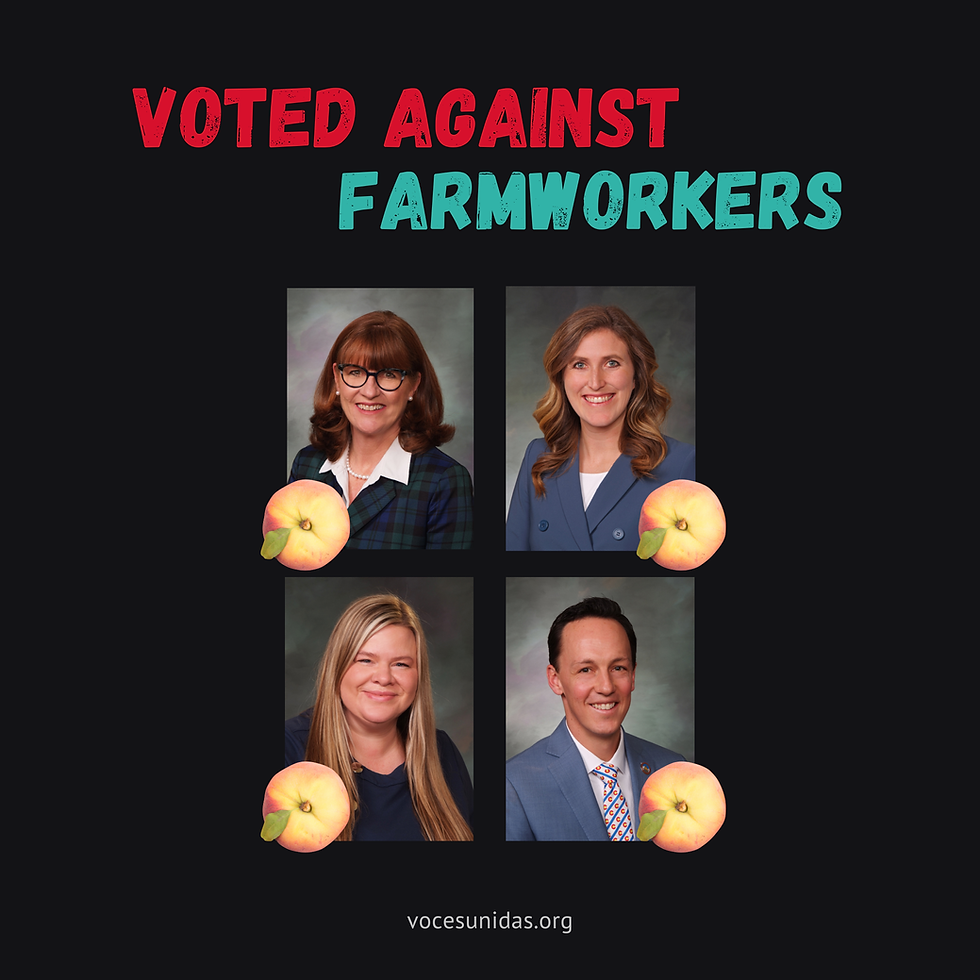
The lawmakers who made that happen should be named.
In the Senate, SB26-121 passed 19 to 16. The Democrats who voted for it were Judy Amabile, Lindsey Daugherty, Nick Hinrichsen, William Lindstedt, Kyle Mullica, Dylan Roberts, and Robert Rodriguez. They were joined by 12 Senate Republicans.
In the House, SB26-121 passed 33 to 32. The Democrats who voted for it were Michael Carter, Monica Duran, Lisa Feret, Meghan Lukens, Matthew Martinez, Tisha Mauro, Karen McCormick, Lesley Smith, Katie Stewart, Alex Valdez, and Speaker Julie McCluskie, whose vote decided the outcome. They were joined by 22 House Republicans.

These are the lawmakers who chose to take back overtime protections from the people who feed Colorado.
This vote is bigger than one bill. It tells farmworkers that the rights they win can still be negotiated downward. It tells Latino and immigrant workers that their labor is essential, but their protections are still treated as conditional.
It tells the people who keep Colorado’s agricultural economy running that they can still be singled out for harsher treatment under the law. It tells every politically vulnerable community in Colorado that even rights already won are only as secure as the willingness of those in power to defend them.
That is the implication of SB26-121. A legislature that will take back a right from farmworkers will not get the benefit of the doubt. A governing majority that crosses this line should be remembered for crossing it.
This is the first time in modern Colorado history that the General Assembly voted to strip a right from an identifiable group of workers after that right had already been won. The date is April 16, 2026. The bill is SB26-121.
Colorado should remember who made it happen.